Fabian Koehler

I’m Fabian Köhler, a physicist-turned-software engineer with a focus on building high-performance, reliable systems. I currently work on satellite-based quantum key distribution (QKD), where I design and implement the post-processing software that turns photon detections into secure cryptographic keys — an essential step for globally scalable, quantum-resistant communication networks.

My background is in theoretical and computational physics, culminating in a PhD where I specialized in numerical methods, high-performance computing, and algorithms for quantum many-body systems. Today, I combine that scientific foundation with modern engineering practices to build robust, efficient software.

I primarily work with C++, Rust, and Python, and I manage complex environments using Nix and Ansible. I’m passionate about Linux, open-source development, and creating clean, maintainable tooling. Furthermore, I enjoy exploring new areas of AI/ML, quantum computing, contributing to open-source projects, playing guitar, and spending time outdoors.
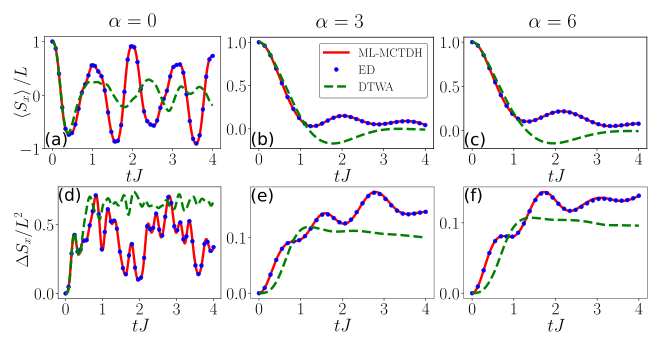
Time-evolution of the collective spin and correlation function of a XYZ model on spin chain with L=16 sites for different interactions according to ED, DTWA, and ML-MCTDH

Ab initio approach to many-body quantum spin dynamics

A fundamental longstanding problem in studying spin models is the efficient and accurate numerical simulation of the long-time behavior of larger systems. The exponential growth of the Hilbert space and the entanglement accumulation at long times pose major challenges for current methods.

April 11, 2025 · 2 min · Aditya Dubey, Zeki Zeybek, Fabian Koehler, Rick Mukherjee, Peter Schmelcher
Left: illustration of the concept of the time-dependent variational principle. Center: tree diagram of a ML-MCTDH wave function. Right: tree diagram of a ML-MCTDHB wave function.

Exploring Ultracold Quantum Many-Body Systems with Multi-Layer Multi-Configurational Approaches

Quantum gases of ultracold atoms are ubiquitous in modern physics as they offer excellent isolation from the environment as well as fine-grained control over their relevant characteristics such as interparticle interactions.

November 1, 2023 · 4 min · Fabian Koehler
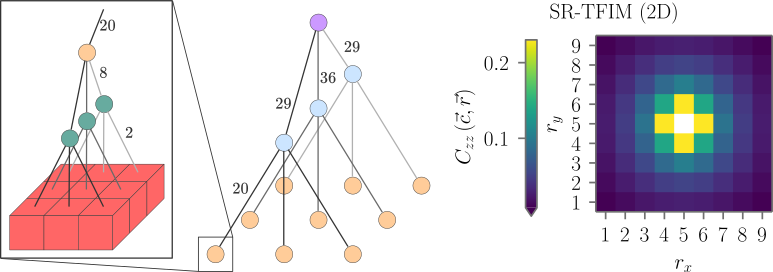
Left: ML-MCTDH tree structure employed to study spin systems on a 2D square lattice. Right: Correlation of the central spin with its neighbors in a 2D short-range TFIM on a 8×8 square lattice.

Exploring disordered quantum spin models with a multilayer multiconfigurational approach

Numerical simulations of quantum spin models are crucial for a profound understanding of many-body phenomena in a variety of research areas in physics. An outstanding problem is the availability of methods to tackle systems that violate area laws of entanglement entropy.

May 30, 2023 · 1 min · Fabian Koehler, Rick Mukherjee, Peter Schmelcher
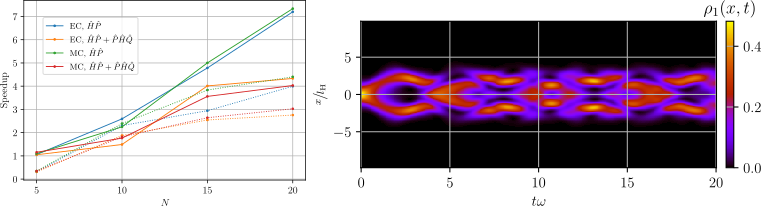
Left: computational speed up of MCTDHB through dynamical pruning for a five-well optical lattice undergoing an interaction quench. Right: time evolution of a bosonic particle clound in a harmonic trap perturbed by a bright laser at the center of the well.

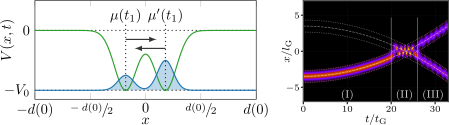
Bosonic quantum dynamics following colliding potential wells

We employ the multiconfiguration time-dependent Hartree method for bosons in order to investigate the correlated nonequilibrium quantum dynamics of two bosons confined in two colliding and uniformly accelerated Gaussian wells.

April 20, 2021 · 1 min · Fabian Koehler, Peter Schmelcher
Left: snapshot of the employed dynamical protocol of two colliding potential wells. Right: examplary evolution of the particle distribution during the collision at an intermediate collision energy.

Dynamical pruning of the non-equilibrium quantum dynamics of trapped ultracold bosons

The investigation of the nonequilibrium quantum dynamics of bosonic many-body systems is very challenging due to the excessively growing Hilbert space and poses a major problem for their theoretical description and simulation.

August 7, 2019 · 1 min · Fabian Koehler, Kevin Keiler, Simeon Mistakidis, Hans-Dieter Meyer, Peter Schmelcher